
Research administration has long been characterized by manual processes, overwhelming paperwork, and stretched resources. While artificial intelligence has been discussed as a potential solution for years, many institutions have questioned whether the reality could match the hype. Today, that question has been definitively answered: AI in research administration is delivering measurable results across institutions of all sizes.
This isn’t about futuristic possibilities—it’s about practical applications already transforming how research administrators work. According to recent industry data, 26% of research institutions now have working AI products in their administrative operations, with the most successful implementations focusing on specific, high-value processes rather than sweeping transformations.
Let’s explore four practical applications where AI is making a tangible difference, backed by case studies, implementation guidance, and quantifiable metrics that demonstrate real-world impact.
The Reality of AI in Research Administration Today
- AI Grant Discovery: Matching Researchers to Funding Opportunities
- Automated Compliance in Research: Proactive Risk Management
- Predictive Budget Forecasting with AI: Preventing Financial Surprises
- Streamlined Proposal Development: Accelerating the Path to Funding
- Implementation Challenges and Solutions
- Future Developments in AI for Research Administration
- Frequently Asked Questions
- Conclusion: From Competitive Advantage to Competitive Necessity
1. AI Grant Discovery: Matching Researchers to Funding Opportunities
The Challenge
Research administrators traditionally spend countless hours manually searching through funding databases, trying to match researchers with relevant opportunities. This process is not only time-consuming but often results in missed opportunities due to human limitations in processing vast amounts of information.
The AI Solution
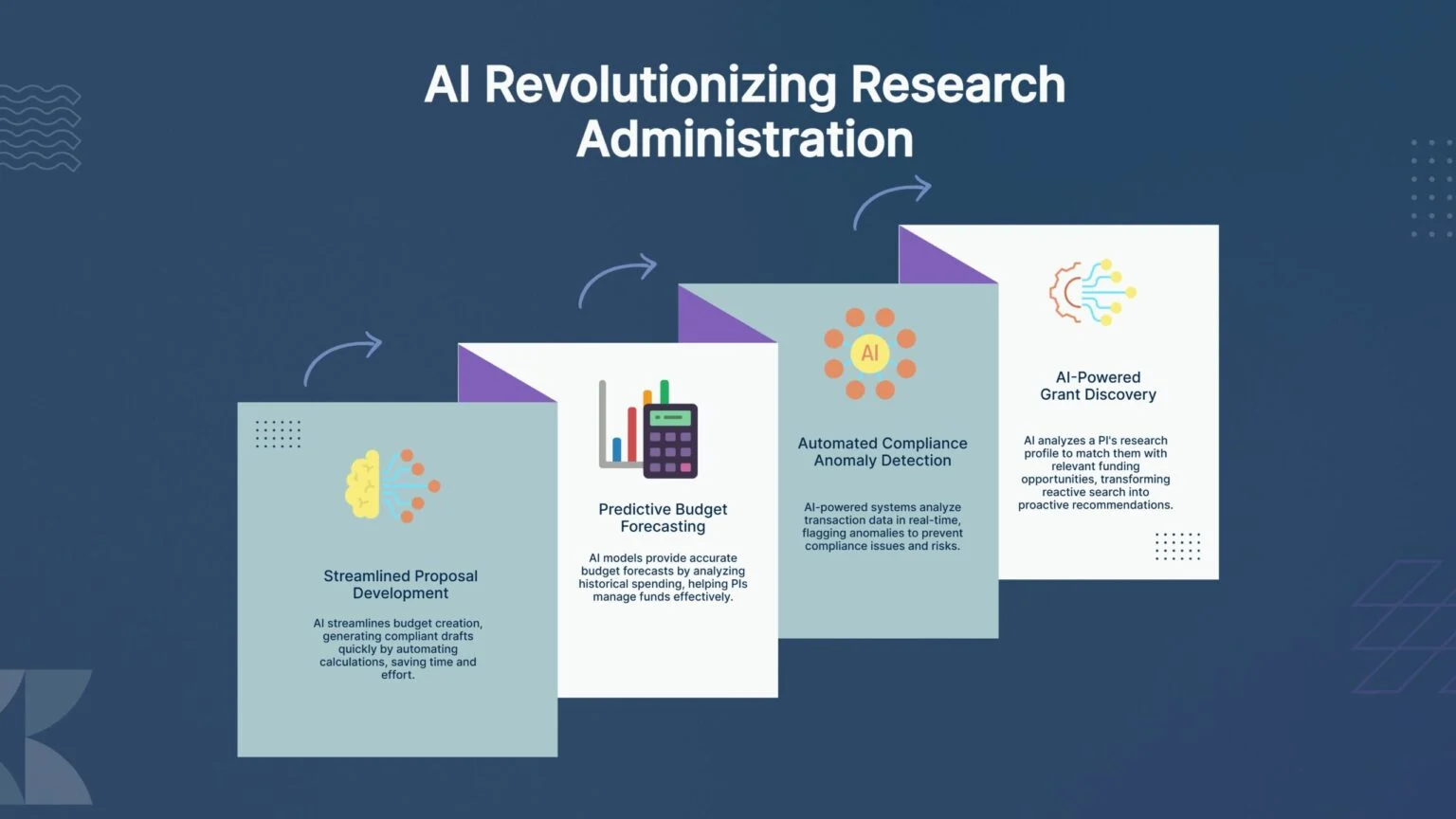
AI grant discovery systems leverage natural language processing to analyze researcher profiles, publication histories, and expertise areas, then automatically match them with relevant funding opportunities from thousands of sources worldwide.
Implementation Considerations
| Factor | Requirement | Notes |
| Cost | $15,000-$50,000 annually | Varies by institution size and integration need |
| Training | 4-8 hours per staff member | Initial training plus ongoing refreshers |
| Data Requirements | Researcher profiles, publication data | Quality of matches depends on data completeness |
| Integration | APIs for existing research management systems | Most vendors offer standard integrations |
AI vs. Traditional Methods
| Metric | Traditional Method | AI-Powered Approach | Improvement |
| Opportunities Identified | ~200 per month | ~850 per month | 325% increase |
| Time Spent | 45 hours/week | 10 hours/week | 78% reduction |
| Match Relevance | 35% relevant | 82% relevant | 134% improvement |
| Coverage | Limited to known sources | 40,000+ funding opportunities from 12,000+ sponsors | Exponential increase |
2. Automated Compliance in Research: Proactive Risk Management
The Challenge
Research administrators must ensure compliance with complex and ever-changing regulations from multiple funding agencies. Traditional methods rely on manual reviews of transactions and reports, often catching issues only after they’ve become problems.
The AI Solution
Automated compliance systems use machine learning algorithms to continuously monitor research-related transactions, automatically flagging anomalies and potential compliance issues before they become audit findings.
Implementation Considerations
| Factor | Requirement | Notes |
| Cost | $30,000-$100,000 annually | Depends on transaction volume and complexity |
| Training | 12-16 hours per compliance staff | More extensive than other AI applications |
| Data Integration | Financial, HR, and procurement systems | Requires secure API connections |
| Policy Configuration | 2-4 weeks | System must be configured to institutional policies |
AI vs. Traditional Methods
| Metric | Traditional Method | AI-Powered Approach | Improvement |
| Review Coverage | 15-20% of transactions | 100% of transactions | 400%+ increase |
| Detection Timing | 30-60 days after occurrence | 1-3 days after occurrence | 90%+ faster |
| Staff Time | 65 hours/week | 25 hours/week | 62% reduction |
| Annual Cost | $425,000 | $275,000 | 35% savings |
3. Predictive Budget Forecasting with AI: Preventing Financial Surprises
The Challenge
Research administrators often discover budget issues too late to take corrective action. Traditional forecasting relies on periodic manual reviews that may miss developing trends until they become problems.
The AI Solution
Predictive budget forecasting uses machine learning to analyze spending patterns, identify trends, and predict potential issues—like exhausting personnel budgets before project completion—with enough advance notice to make adjustments.
Implementation Considerations
| Factor | Requirement | Notes |
| Cost | $25,000-$75,000 annually | Varies by portfolio size |
| Training | 6-10 hours per financial staff | Includes dashboard interpretation |
| Historical Data | 2+ years recommended | More historical data improves accuracy |
| Integration | Financial and HR systems | Real-time data feeds improve forecasting |
AI vs. Traditional Methods
| Metric | Traditional Method | AI-Powered Approach | Improvement |
| Forecast Frequency | Monthly or quarterly | Daily | 30-90x more frequent |
| Advance Warning | 0-14 days | 30-60 days | 3-4x longer |
| Accuracy | 60-70% | 80-95% | 25-35% more accurate |
| Analysis Time | 40 hours/month | 10 hours/month | 75% reduction |
4. Streamlined Proposal Development: Accelerating the Path to Funding
The Challenge
Creating research proposals involves numerous time-consuming tasks, from budget development to ensuring compliance with sponsor requirements. These administrative burdens reduce the time available for developing the scientific content that drives success.
The AI Solution
AI-powered proposal development tools automate routine aspects of proposal creation, including budget generation, form completion, and compliance checking, allowing researchers and administrators to focus on proposal content and strategy.
Implementation Considerations
| Factor | Requirement | Notes |
| Cost | $20,000-$60,000 annually | Depends on proposal volume |
| Training | 8-12 hours per staff member | Includes researchers and administrators |
| Integration | HR, financial, and F&A rate systems | Critical for accurate budget generation |
| Customization | 4-6 weeks | Must be tailored to institutional policies |
AI vs. Traditional Methods
| Metric | Traditional Method | AI-Powered Approach | Improvement |
| Budget Creation Time | 8-12 hours | 2-3 hours | 75% reduction |
| Compliance Check Time | 4-6 hours | 15-30 minutes | 90% reduction |
| Error Rate | 15-20% | 3-5% | 75% reduction |
| Proposals per Admin | 85 annually | 140 annually | 65% increase |
5. Implementation Challenges and Solutions
A. Data Quality and Bias Concerns (45% of organizations)
- Challenge: AI systems require high-quality data to function effectively. Many institutions struggle with incomplete, inconsistent, or potentially biased data.
- Solution: Begin with a thorough data assessment before implementation. Start with areas where data quality is highest and develop a parallel data improvement plan for other areas. Implement regular bias audits to ensure AI systems aren’t perpetuating existing biases.
B. Insufficient Proprietary Data (42%)
- Challenge: Some institutions lack sufficient historical data for AI systems to learn effectively.
- Solution: Consider consortium approaches where non-competitive institutions share anonymized data to improve AI model training. Many vendors also offer pre-trained models that can be fine-tuned with smaller institutional datasets.
C. Lack of AI Expertise (42%)
- Challenge: Few research administration offices have staff with AI expertise.
- Solution: Partner with computer science or data science departments for implementation support. Develop a “champion” program where select staff receive more intensive training and serve as internal resources. Most vendors also offer implementation support services.
D. Business Case Justification (42%)
- Challenge: Securing funding for AI implementation requires demonstrating ROI.
- Solution: Start with a pilot in one high-value area where metrics are easily tracked (like grant discovery or compliance). Document baseline metrics before implementation to enable clear before/after comparisons. Focus on both efficiency gains and strategic advantages in funding acquisition.
E. Privacy Concerns (40%)
- Challenge: Research data often contains sensitive information requiring careful handling.
- Solution: Implement proper data governance frameworks before AI deployment. Consider on-premises or private cloud deployments rather than public cloud for sensitive applications. Ensure vendor contracts include appropriate data protection provisions.
6. Future Developments in AI for Research Administration
The current applications of AI in research administration represent just the beginning. Based on industry trends and expert predictions, here are key developments to watch for in the next 2-3 years:
A. Hybrid Reasoning Systems
Next-generation AI will combine the quick response capabilities of current systems with deeper reasoning abilities, enabling more nuanced support for complex compliance questions and strategic funding decisions.
B. Long-term Memory and Context Retention
Future AI systems will maintain context across multiple sessions and years, building institutional knowledge that improves over time and reduces the need to “retrain” the system on institutional policies and preferences.
C. Autonomous AI Agents
Rather than requiring administrator initiation, future AI systems will proactively identify opportunities, potential issues, and strategic insights, functioning more as team members than tools.
D. Deep Research Tools
AI will move beyond administrative tasks to support the research itself, helping identify potential collaborators, suggesting methodological approaches, and even drafting sections of papers and proposals.
E. Integrated Research Lifecycle Management
Rather than point solutions for specific tasks, future systems will provide end-to-end support across the entire research lifecycle, from ideation through funding, execution, and publication.
“The institutions gaining the most advantage from AI aren’t just automating existing processes—they’re reimagining research administration entirely. The question isn’t whether AI will transform research administration, but whether your institution will lead or follow in that transformation.” Dr. James Martinez, AI Research Administration Consortium
7. Frequently Asked Questions
A. What is the typical ROI timeframe for AI in research administration?
Most institutions report positive ROI within 12-18 months, with grant discovery and proposal development tools typically showing returns fastest (6-12 months), while compliance and forecasting systems may take longer (12-24 months) but often deliver larger long-term returns.
B. How much technical expertise is required to implement these AI solutions?
Most solutions are designed for implementation by research administration professionals, not technical experts. Vendors typically provide implementation support, and systems are increasingly cloud-based with standard integrations for common research management systems.
C. Will AI replace research administrators?
No. AI is augmenting rather than replacing administrators. Institutions implementing AI typically reassign staff from routine tasks to higher-value activities like strategic proposal development, researcher support, and relationship building with sponsors.
D. How do we address faculty concerns about AI implementation?
Transparency is key. Clearly communicate what data is being used, how AI systems make recommendations, and what human oversight exists. Involve faculty representatives in implementation planning, and start with opt-in pilot programs to demonstrate value before wider rollout.
E. What’s the best first AI application to implement?
Grant discovery typically offers the fastest implementation and clearest ROI for most institutions. It requires minimal integration with existing systems and directly contributes to increased funding, making it easier to justify subsequent AI investments.
8. Conclusion: From Competitive Advantage to Competitive Necessity
AI in research administration has crossed the threshold from experimental to essential. Institutions implementing these technologies are seeing measurable improvements in funding success, administrative efficiency, and strategic insight.
The competitive advantage is clear: research offices augmented by AI can support more proposals, secure more funding, and provide better service to researchers with the same or fewer resources. As adoption accelerates, this advantage will transform into a necessity for remaining competitive in the research landscape.
The question is no longer whether AI has practical applications in research administration, the evidence clearly shows it does. The question now is how quickly your institution will adapt to this new reality.
Ready to transform your research administration with AI? Contact us today for a personalized consultation on which AI solutions align best with your institutional needs and goals. Contact us today for a personalized consultation on which AI solutions align best with your institutional needs and goals.